

ISO 14001 Certification in Saudi Arabia FAQs: Everything You Need to Know
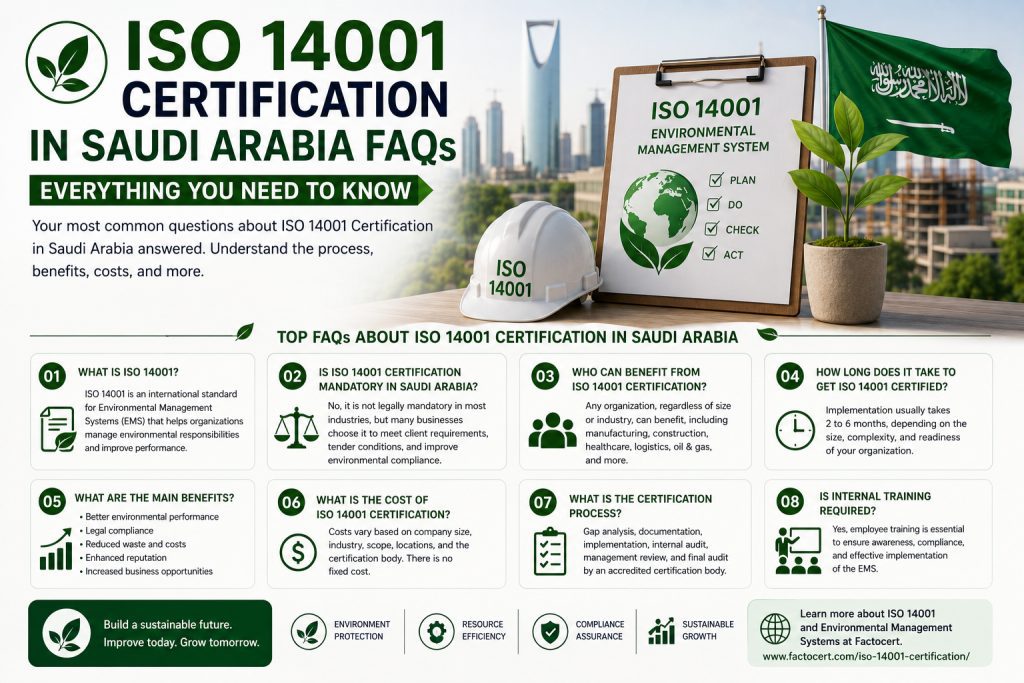
Organizations across Saudi Arabia are placing greater emphasis on environmental responsibility, regulatory compliance, and sustainable business practices. As a result, many companies are exploring ISO 14001 certification to strengthen their Environmental Management Systems (EMS). If you’re researching ISO 14001 Certification FAQs Saudi Arabia, you’re likely looking for clear answers about the certification process, costs, timelines, and business benefits.
This guide answers the most common ISO 14001 Certification FAQs Saudi Arabia to help business owners, managers, and decision-makers understand what to expect before beginning their certification journey.
ISO 14001 Certification FAQs Saudi Arabia: What Is ISO 14001?
One of the most frequently asked ISO 14001 Certification FAQs Saudi Arabia is about what ISO 14001 actually is.
ISO 14001 is an internationally recognized standard for Environmental Management Systems (EMS). It provides organizations with a structured framework to identify environmental impacts, improve resource efficiency, reduce waste, and comply with applicable environmental regulations.
The standard is suitable for organizations of all sizes and industries, including manufacturing, construction, logistics, healthcare, hospitality, and energy.
For official information, visit the ISO 14001 Environmental Management Systems page published by the International Organization for Standardization.
Who Should Obtain ISO 14001 Certification?
Another common question included in ISO 14001 Certification FAQs Saudi Arabia is whether every company needs certification.
While ISO 14001 certification is voluntary, it offers significant advantages for organizations that:
- Want to improve environmental performance
- Need to meet customer or contractual requirements
- Participate in government or international tenders
- Reduce environmental risks
- Demonstrate commitment to sustainability
- Improve operational efficiency
Businesses across Saudi Arabia increasingly pursue ISO 14001 certification as environmental expectations continue to grow across industries.
How Does the Certification Process Work?
Many businesses researching ISO 14001 Certification FAQs Saudi Arabia want to understand the certification process.
The typical implementation includes:
- Initial gap analysis
- Identification of environmental aspects and impacts
- Development of Environmental Management System documentation
- Employee training
- System implementation
- Internal audit
- Management review
- Certification audit by an accredited certification body
Organizations interested in understanding the complete certification process can refer to ISO 14001 certification in Saudi Arabia for additional guidance.
How Long Does ISO 14001 Certification Take?
Implementation time depends on several factors, including:
- Company size
- Operational complexity
- Existing management systems
- Employee readiness
- Availability of documentation
For many small and medium-sized businesses, implementation may take between two and six months. Larger organizations with multiple locations may require additional time.
Proper planning and employee involvement often help reduce delays during implementation.
What Factors Affect Certification Costs?
One of the most searched ISO 14001 Certification FAQs Saudi Arabia relates to certification costs.
There is no fixed certification fee because costs vary depending on:
- Organization size
- Number of employees
- Number of business locations
- Industry risks
- Scope of certification
- Certification body fees
- Consultancy requirements
Instead of focusing only on initial costs, businesses should also consider the long-term value of improved efficiency, regulatory compliance, and reduced environmental risks.
What Are the Main Benefits of ISO 14001 Certification?
Organizations implementing ISO 14001 often experience benefits that extend beyond environmental compliance.
Some key advantages include:
- Improved environmental performance
- Better legal and regulatory compliance
- Reduced waste generation
- Lower energy and resource consumption
- Enhanced corporate reputation
- Increased stakeholder confidence
- Better operational efficiency
- Stronger risk management
- Greater opportunities in competitive markets
These benefits help organizations improve sustainability while supporting long-term business growth.
Businesses interested in expanding their understanding of ISO standards and certification practices can also explore educational resources available through Factocert.
Is ISO 14001 Certification Mandatory in Saudi Arabia?
Another important topic covered in ISO 14001 Certification FAQs Saudi Arabia is whether certification is legally required.
In most industries, ISO 14001 certification is not mandatory by law. However, many organizations pursue certification because customers, government agencies, or international business partners may require certified Environmental Management Systems during procurement and tender processes.
Certification also demonstrates a company’s commitment to responsible environmental management.
Conclusion
Understanding the most common ISO 14001 Certification FAQs Saudi Arabia helps organizations make informed decisions before beginning certification. From understanding implementation requirements and timelines to evaluating costs and business benefits, ISO 14001 provides a practical framework for improving environmental performance and operational efficiency.
As environmental expectations continue to evolve, organizations that implement ISO 14001 are better positioned to strengthen compliance, improve sustainability, and enhance long-term business performance.