

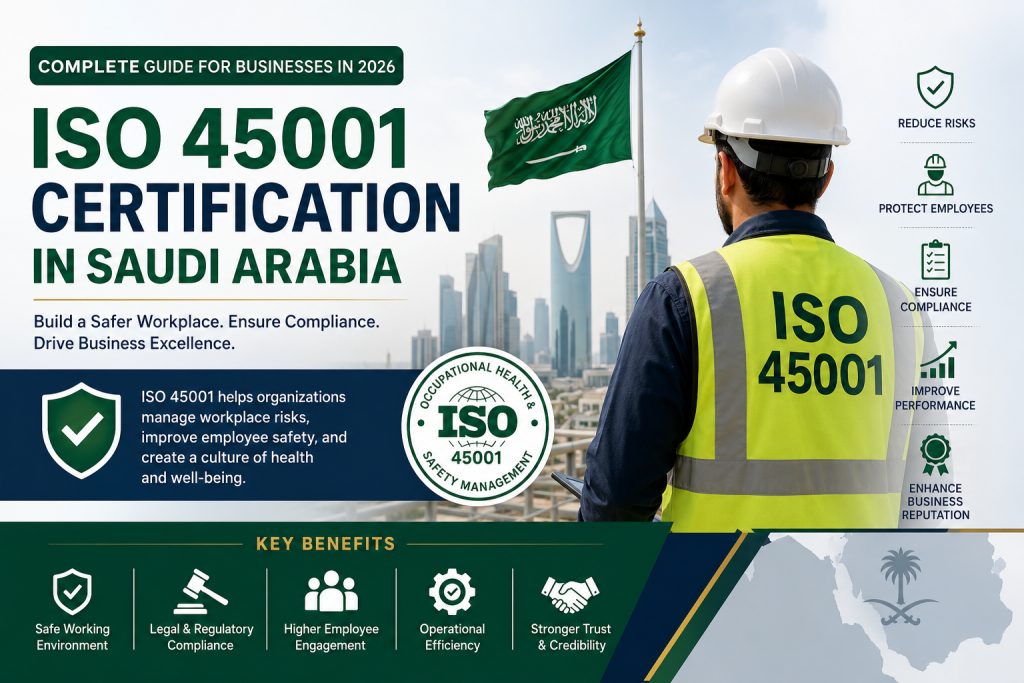
Workplace safety has become a top priority for organizations across Saudi Arabia. As industries expand and regulations continue to evolve, businesses are expected to create safer working environments while reducing occupational risks. This is where ISO 45001 Certification in Saudi Arabia plays an important role. The standard provides a structured framework for managing occupational health and safety (OH&S), helping organizations prevent workplace injuries, improve compliance, and build a stronger safety culture. Whether you operate in construction, manufacturing, healthcare, logistics, or energy, understanding ISO 45001 can help your business meet legal obligations and support long-term operational success.
Why ISO 45001 Certification in Saudi Arabia Matters
ISO 45001 Certification in Saudi Arabia is based on the internationally recognized ISO 45001 standard for Occupational Health and Safety Management Systems (OHSMS). It helps organizations identify workplace hazards, assess risks, and implement effective controls to protect employees and other stakeholders.
Saudi Arabia’s growing industrial sector, major infrastructure projects, and emphasis on workplace safety make ISO 45001 increasingly valuable for organizations seeking sustainable growth.
Some of the key benefits include:
- Reduced workplace accidents and occupational illnesses
- Improved compliance with health and safety regulations
- Increased employee confidence and engagement
- Better operational efficiency through risk management
- Enhanced reputation with customers, partners, and regulatory bodies
- Improved readiness for supplier and client audits
Steps to Achieve ISO 45001 Certification in Saudi Arabia
Obtaining ISO 45001 Certification in Saudi Arabia follows a structured process that organizations of all sizes can adopt.
1. Understand the Standard
Study the requirements of ISO 45001 and determine how they apply to your organization’s operations and workplace risks.
2. Conduct a Gap Analysis
Review existing health and safety practices to identify areas that need improvement before implementing the management system.
3. Develop an Occupational Health and Safety Management System
Create documented policies, procedures, objectives, and risk assessment methods that align with ISO 45001 requirements.
4. Train Employees
Employees should understand workplace hazards, emergency procedures, and their responsibilities within the safety management system.
5. Perform Internal Audits
Regular internal audits help verify whether the management system is working effectively and identify opportunities for continual improvement.
6. Certification Audit
An accredited certification body conducts an external audit to verify compliance with ISO 45001 requirements before issuing certification.
Organizations looking for additional implementation guidance can refer to resources on ISO 45001 Certification in Saudi Arabia to better understand the certification journey.
Which Businesses Benefit Most from ISO 45001?
Although every organization can improve workplace safety, ISO 45001 Certification in Saudi Arabia is especially valuable for industries with higher occupational risks.
These include:
- Construction and engineering
- Oil and gas
- Manufacturing
- Logistics and transportation
- Healthcare facilities
- Food processing
- Mining
- Warehousing
- Utilities and energy
Even service-based businesses benefit by reducing workplace incidents, improving employee wellbeing, and strengthening organizational processes.
Common Challenges During Implementation
Many organizations face obstacles while implementing ISO 45001, but most challenges can be addressed with careful planning.
Common issues include:
- Limited employee awareness of safety responsibilities
- Incomplete hazard identification
- Poor documentation practices
- Lack of management involvement
- Irregular internal audits
- Failure to monitor safety performance consistently
Successful organizations encourage participation from employees at every level and treat occupational health and safety as an ongoing process rather than a one-time project.
Businesses interested in learning more about ISO standards, management systems, and certification practices can also explore educational resources available through Factocert.
Maintaining ISO 45001 Certification for Long-Term Success
Achieving certification is only the beginning. Maintaining ISO 45001 Certification in Saudi Arabia requires continuous monitoring and improvement to ensure the management system remains effective.
Organizations should:
- Review workplace risks regularly
- Update safety objectives as operations evolve
- Conduct periodic internal audits
- Monitor incidents and corrective actions
- Provide ongoing employee training
- Hold regular management review meetings
Continuous improvement is one of the core principles of ISO 45001, helping organizations adapt to changing workplace conditions and regulatory requirements.
For detailed information about the ISO 45001 standard, organizations can refer to the official ISO 45001 page published by the International Organization for Standardization: https://www.iso.org/iso-45001-occupational-health-and-safety.html.
Conclusion
Creating a safe and healthy workplace is no longer just a compliance requirement—it is an essential part of responsible business management. ISO 45001 Certification in Saudi Arabia provides organizations with a practical framework for identifying workplace hazards, reducing risks, and improving occupational health and safety performance. By following a structured implementation process, involving employees, and focusing on continual improvement, businesses can strengthen workplace safety while supporting operational excellence. As Saudi Arabia continues its economic development, organizations that invest in effective health and safety management will be better prepared for future growth and evolving industry expectations.