

ISO 14001 Certification in Saudi Arabia for Construction Companies: Benefits and Process
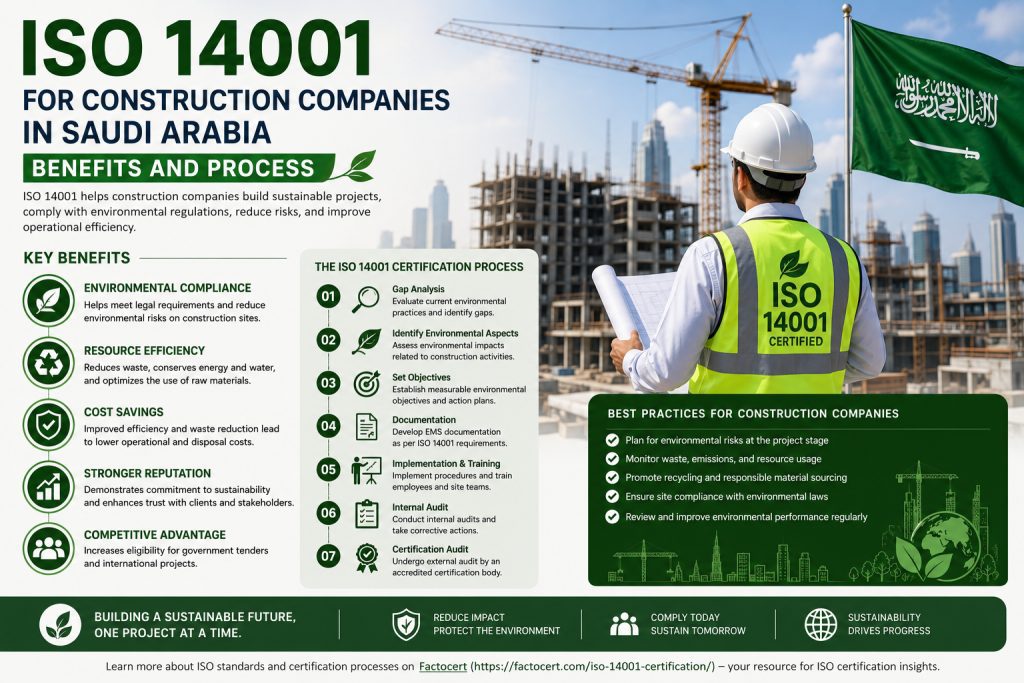
ISO 14001 for Construction Companies in Saudi Arabia is becoming increasingly important as the construction sector expands through ambitious infrastructure and development projects under Saudi Vision 2030. Construction activities can have a significant environmental impact, from waste generation and resource consumption to emissions and noise pollution. Implementing an Environmental Management System (EMS) based on ISO 14001 helps construction companies manage these impacts while improving operational efficiency and regulatory compliance.
Whether your organization is involved in residential, commercial, industrial, or infrastructure projects, understanding ISO 14001 for Construction Companies in Saudi Arabia can help you build more sustainable operations and strengthen your competitive position in the industry.
Why ISO 14001 for Construction Companies in Saudi Arabia Matters
Construction companies operate in environments where environmental risks are unavoidable. Activities such as excavation, material handling, waste disposal, and energy consumption require careful planning and monitoring.
Implementing ISO 14001 for Construction Companies in Saudi Arabia provides a structured framework to identify environmental aspects, evaluate risks, establish environmental objectives, and continually improve performance.
According to the official ISO 14001 Environmental Management Systems guidance, ISO 14001 enables organizations to improve environmental performance while fulfilling compliance obligations and achieving sustainability goals.
Benefits of ISO 14001 for Construction Companies in Saudi Arabia
Improved Environmental Compliance
Construction projects must comply with various environmental regulations relating to waste management, emissions, water conservation, and pollution control.
By implementing ISO 14001 for Construction Companies in Saudi Arabia, businesses can:
- Identify applicable environmental regulations
- Reduce compliance risks
- Improve documentation
- Demonstrate environmental responsibility during audits
This proactive approach minimizes legal risks and supports long-term operational stability.
Better Resource Management
Construction companies consume large amounts of raw materials, fuel, water, and electricity.
An Environmental Management System helps organizations:
- Reduce material waste
- Improve energy efficiency
- Optimize water usage
- Increase recycling efforts
- Lower operational costs
These improvements contribute to both sustainability and profitability.
Enhanced Reputation and Business Opportunities
Many government agencies, multinational organizations, and private developers prefer contractors that demonstrate responsible environmental practices.
Implementing ISO 14001 for Construction Companies in Saudi Arabia strengthens an organization’s reputation and may improve eligibility for tenders, contracts, and international projects.
Improved Risk Management
Construction activities often involve environmental risks that can lead to project delays or financial losses.
ISO 14001 encourages organizations to identify potential environmental risks early and implement preventive measures before issues escalate.
The Certification Process
Obtaining ISO 14001 for Construction Companies in Saudi Arabia involves several structured steps designed to build an effective Environmental Management System.
The typical certification process includes:
- Conducting a gap analysis.
- Identifying environmental aspects and impacts.
- Establishing environmental objectives.
- Preparing Environmental Management System documentation.
- Training employees and project teams.
- Implementing operational controls.
- Conducting internal audits.
- Completing certification through an accredited certification body.
Organizations seeking additional information about certification requirements can refer to ISO 14001 certification in Saudi Arabia for a detailed overview of the implementation process.
Best Practices for Successful Implementation
Construction companies can maximize the benefits of ISO 14001 for Construction Companies in Saudi Arabia by adopting practical environmental management practices throughout every project.
Recommended best practices include:
- Monitoring environmental performance regularly
- Training employees on environmental responsibilities
- Conducting routine site inspections
- Managing construction waste efficiently
- Reducing emissions and energy consumption
- Reviewing environmental objectives periodically
- Maintaining accurate Environmental Management System records
Organizations interested in learning more about environmental management systems can also explore ISO 14001 Certification as an additional educational resource.
Supporting Sustainable Construction in Saudi Arabia
Saudi Arabia continues to invest heavily in smart cities, transportation infrastructure, renewable energy projects, and large-scale developments. Sustainable construction has become an essential component of these initiatives.
Implementing ISO 14001 for Construction Companies in Saudi Arabia enables contractors to align with international environmental standards while supporting national sustainability objectives. Companies that actively manage environmental impacts are often better positioned to improve operational efficiency, reduce project risks, and build stronger relationships with clients and stakeholders.
Conclusion
Implementing ISO 14001 for Construction Companies in Saudi Arabia helps construction organizations improve environmental performance, strengthen compliance, reduce waste, and manage operational risks more effectively. Rather than treating certification as a one-time achievement, companies should integrate environmental management into daily operations and project planning.
As the Saudi construction industry continues to grow, adopting ISO 14001 for Construction Companies in Saudi Arabia provides a practical framework for sustainable development, operational excellence, and long-term business success.