

Why Your Business Needs ISO 45001 Certification in Saudi Arabia
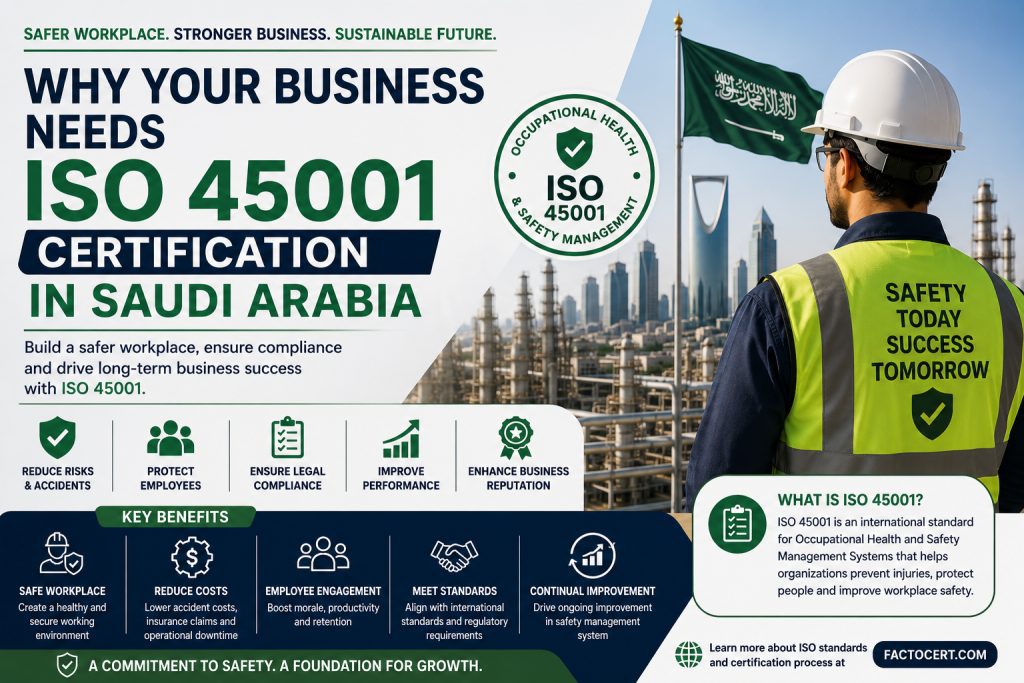
Protecting employees and maintaining a safe workplace are essential responsibilities for every business. As industries across Saudi Arabia continue to expand, organizations face increasing expectations to manage occupational health and safety effectively while complying with legal requirements. ISO 45001 Certification in Saudi Arabia provides a globally recognized framework that helps businesses reduce workplace risks, prevent accidents, and create a culture of continuous improvement. Whether you manage a manufacturing plant, construction company, logistics operation, or healthcare facility, adopting ISO 45001 can strengthen both employee well-being and business performance.
Why ISO 45001 Certification in Saudi Arabia Matters
ISO 45001 Certification in Saudi Arabia is based on the international ISO 45001 standard for Occupational Health and Safety Management Systems (OHSMS). It enables organizations to identify hazards, evaluate risks, and implement controls that reduce workplace incidents and improve operational efficiency.
As Saudi Arabia continues to invest in infrastructure, industrial development, and economic diversification under Vision 2030, organizations are expected to maintain higher workplace safety standards. Implementing ISO 45001 helps businesses meet these expectations while supporting sustainable growth.
Key Benefits of ISO 45001 Certification in Saudi Arabia
Adopting ISO 45001 offers advantages that extend beyond regulatory compliance.
Some of the most significant benefits include:
- Reduces workplace accidents and occupational illnesses
- Improves compliance with health and safety regulations
- Creates a proactive workplace safety culture
- Increases employee confidence and participation
- Improves operational efficiency through better risk management
- Strengthens credibility with customers, partners, and stakeholders
- Supports continual improvement of workplace safety practices
Organizations that effectively manage occupational health and safety often experience fewer operational disruptions, reduced downtime, and improved workforce productivity.
Businesses seeking detailed guidance on implementation can refer to ISO 45001 Certification in Saudi Arabia to better understand the certification process and management system requirements.
Industries That Benefit the Most
Although every organization can benefit from better workplace safety, ISO 45001 Certification in Saudi Arabia is especially valuable for industries where operational risks are higher.
These include:
- Construction
- Oil and gas
- Manufacturing
- Logistics and transportation
- Healthcare
- Warehousing
- Utilities
- Mining
- Food processing
Even businesses operating in office environments benefit from implementing structured occupational health and safety processes that improve employee wellbeing and organizational resilience.
How ISO 45001 Supports Long-Term Business Growth
Many organizations initially pursue ISO 45001 to improve compliance, but the long-term benefits often have a much greater business impact.
A well-implemented Occupational Health and Safety Management System helps organizations:
- Identify risks before they become serious incidents
- Reduce costs associated with workplace injuries
- Improve employee retention and satisfaction
- Strengthen relationships with clients and business partners
- Enhance organizational reputation
- Support continual operational improvement
Rather than treating safety as a standalone activity, ISO 45001 integrates occupational health and safety into daily business operations and strategic decision-making.
Businesses interested in learning more about ISO management systems and certification practices can also explore educational resources available through Factocert.
Steps Toward Achieving Certification
Obtaining ISO 45001 Certification in Saudi Arabia follows a structured implementation process.
The main stages typically include:
- Understanding ISO 45001 requirements
- Conducting a gap analysis
- Developing the Occupational Health and Safety Management System
- Training employees
- Performing internal audits
- Completing the certification audit through an accredited certification body
Following these steps helps organizations establish an effective management system while preparing successfully for certification.
For official information about ISO 45001 requirements, businesses can refer to the International Organization for Standardization’s guidance on the ISO 45001 Occupational Health and Safety Management System:
https://www.iso.org/iso-45001-occupational-health-and-safety.html
Building a Culture of Workplace Safety
One of the greatest strengths of ISO 45001 Certification in Saudi Arabia is its focus on continual improvement and employee involvement.
Organizations are encouraged to:
- Regularly review workplace hazards
- Update risk assessments
- Encourage employee participation
- Monitor safety performance
- Investigate incidents and implement corrective actions
- Review objectives through management meetings
Over time, these practices contribute to a stronger safety culture where risk awareness becomes part of everyday operations.
Conclusion
ISO 45001 Certification in Saudi Arabia is more than a compliance requirement—it is a practical framework for improving workplace safety, managing occupational risks, and supporting sustainable business growth. By implementing an effective Occupational Health and Safety Management System, organizations can reduce workplace incidents, strengthen employee engagement, improve operational performance, and meet internationally recognized safety standards. As workplace expectations continue to evolve, businesses that invest in health and safety management will be better positioned for long-term success.