

Common Mistakes to Avoid When Applying for ISO 14001 Certification in Saudi Arabia
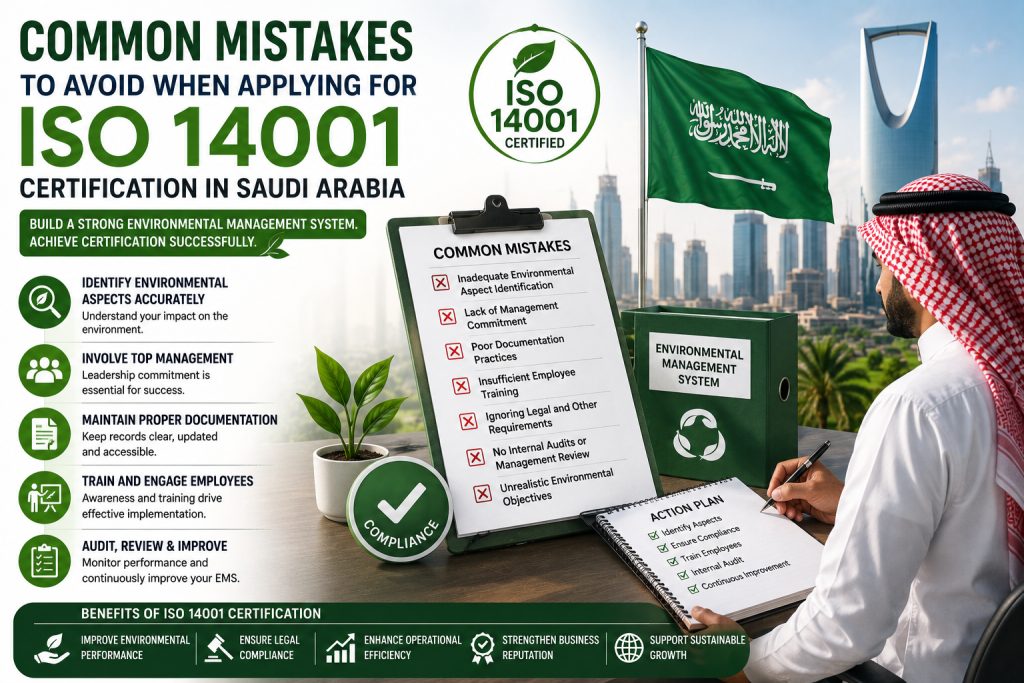
Environmental sustainability has become an important focus for organizations across Saudi Arabia as industries work toward greater efficiency and regulatory compliance. Implementing ISO 14001 Certification in Saudi Arabia helps businesses establish an effective Environmental Management System (EMS) that minimizes environmental impact while improving operational performance. However, many organizations encounter challenges during implementation because they overlook key requirements or underestimate the certification process.
Understanding the common mistakes before beginning ISO 14001 Certification in Saudi Arabia can save valuable time, reduce costs, and increase the likelihood of a successful certification audit. This guide highlights the most frequent errors and explains how businesses can avoid them.
Why Proper Planning Matters for ISO 14001 Certification in Saudi Arabia
ISO 14001 is the internationally recognized standard for Environmental Management Systems, developed by the International Organization for Standardization (ISO). It provides a structured framework for managing environmental responsibilities, identifying risks, improving resource efficiency, and complying with environmental regulations.
Organizations pursuing ISO 14001 Certification in Saudi Arabia should understand that certification is not simply about documentation. It requires active participation from leadership, employee involvement, continual improvement, and effective environmental management practices. The official ISO 14001 Environmental Management Systems page provides detailed guidance on the standard and its requirements.
Common Mistakes to Avoid During ISO 14001 Certification in Saudi Arabia
1. Treating Certification as a Documentation Exercise
One of the most common mistakes is assuming that preparing documents alone is enough.
An Environmental Management System should become part of everyday business operations rather than existing only for audit purposes. Organizations should ensure employees understand procedures and consistently follow them throughout daily activities.
2. Failing to Identify Environmental Aspects
Successful ISO 14001 Certification in Saudi Arabia begins with identifying how business activities affect the environment.
Many organizations fail to properly evaluate:
- Energy consumption
- Water usage
- Waste generation
- Air emissions
- Resource utilization
- Noise pollution
Without identifying these environmental aspects, businesses cannot effectively establish environmental objectives or operational controls.
3. Lack of Management Commitment
Leadership involvement is essential for successful implementation.
Senior management should:
- Establish environmental objectives
- Allocate adequate resources
- Support employee training
- Monitor Environmental Management System performance
- Participate in management reviews
Without strong leadership support, organizations often struggle to maintain an effective Environmental Management System.
Operational Mistakes That Delay Certification
4. Inadequate Employee Training
Employees play an important role in maintaining environmental performance.
Organizations pursuing ISO 14001 Certification in Saudi Arabia should provide training that helps employees understand:
- Environmental responsibilities
- Emergency response procedures
- Operational controls
- Waste management practices
- Continual improvement objectives
Well-trained employees contribute significantly to successful implementation.
5. Ignoring Internal Audits
Some businesses postpone internal audits until shortly before the certification audit.
Internal audits should be conducted regularly because they help identify non-conformities early and allow organizations to implement corrective actions before external auditors arrive.
6. Setting Unrealistic Environmental Objectives
Environmental objectives should be measurable, practical, and aligned with organizational activities.
Instead of setting overly ambitious goals, businesses should establish achievable targets that can be monitored and improved over time.
Best Practices for Successful ISO 14001 Certification in Saudi Arabia
Organizations can improve their chances of certification success by following several best practices.
These include:
- Conducting a thorough gap analysis
- Identifying environmental aspects and impacts
- Developing practical Environmental Management System documentation
- Training employees regularly
- Monitoring legal compliance
- Performing scheduled internal audits
- Reviewing environmental objectives periodically
- Implementing corrective actions promptly
Businesses looking for more information about the certification process can learn more through ISO 14001 certification in Saudi Arabia to better understand implementation requirements and certification stages.
Organizations interested in expanding their understanding of ISO management systems can also refer to ISO 14001 Certification for additional technical information about environmental management practices.
Benefits of Avoiding These Mistakes
When organizations avoid common implementation errors, they often experience:
- Faster certification timelines
- Better environmental compliance
- Reduced operational risks
- Improved resource efficiency
- Lower waste generation
- Greater employee engagement
- Stronger stakeholder confidence
- Improved business reputation
More importantly, an effective Environmental Management System becomes part of continual business improvement rather than simply a certification requirement.
Conclusion
Achieving ISO 14001 Certification in Saudi Arabia requires careful planning, leadership commitment, employee involvement, and continual improvement. Organizations that avoid common mistakes such as poor planning, inadequate training, weak environmental assessments, and neglected internal audits are more likely to achieve successful certification while maximizing the long-term benefits of their Environmental Management System.
By approaching ISO 14001 Certification in Saudi Arabia strategically, businesses can improve environmental performance, strengthen regulatory compliance, enhance operational efficiency, and support sustainable growth for years to come.