

ISO 14001 Certification in Saudi Arabia: Requirements, Cost, and Timeline Explained
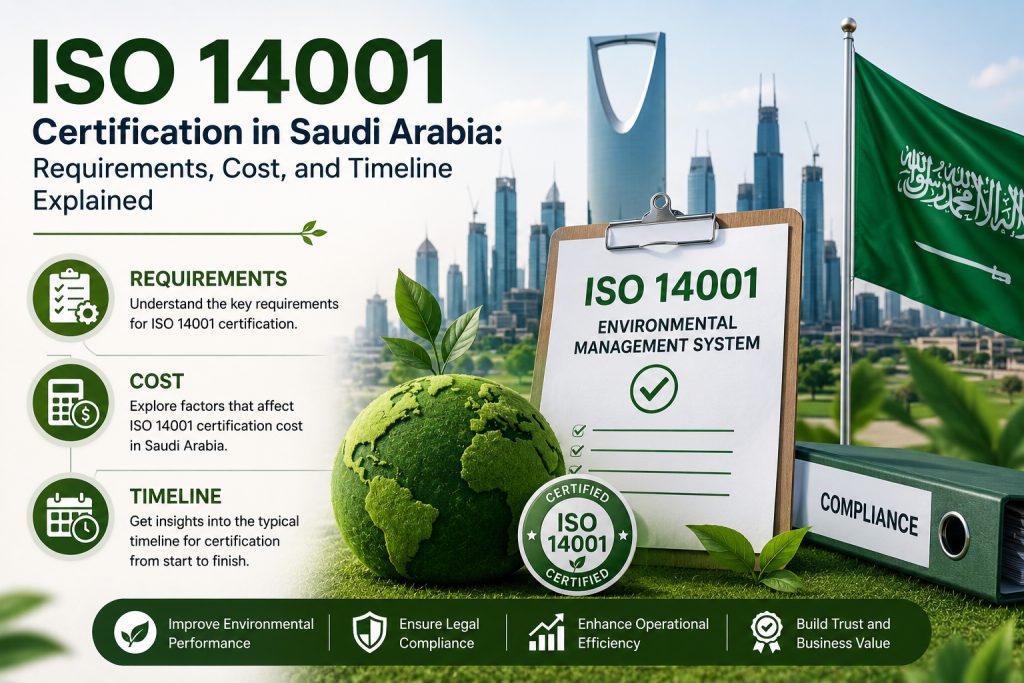
As environmental sustainability becomes a priority across industries, businesses in Saudi Arabia are increasingly adopting internationally recognized environmental management practices. Whether you’re a manufacturing company, construction firm, healthcare provider, or logistics business, understanding the ISO 14001 Certification Cost in Saudi Arabia is an important step before beginning the certification journey.
While the investment required varies from one organization to another, ISO 14001 certification offers long-term value by improving environmental performance, ensuring regulatory compliance, and enhancing business credibility. This guide explains the certification requirements, the factors that influence the ISO 14001 Certification Cost in Saudi Arabia, and the typical timeline for achieving certification.
Understanding ISO 14001 Certification Requirements
ISO 14001 is the international standard for Environmental Management Systems (EMS), developed by the International Organization for Standardization (ISO). It provides organizations with a structured framework to identify environmental impacts, manage risks, comply with legal requirements, and improve environmental performance.
To obtain certification, organizations generally need to:
- Develop an Environmental Management System (EMS)
- Establish an environmental policy
- Identify environmental aspects and impacts
- Meet applicable legal and regulatory requirements
- Set measurable environmental objectives
- Train employees on EMS procedures
- Conduct internal audits and management reviews
- Successfully complete an external certification audit
The official ISO 14001 Environmental Management Systems page provides comprehensive information about the standard and its requirements.
Factors That Influence ISO 14001 Certification Cost in Saudi Arabia
The ISO 14001 Certification Cost in Saudi Arabia is not fixed because every organization has unique operational requirements. Several factors determine the total investment.
Organization Size
Larger organizations typically require more documentation, employee training, and audit time. Businesses operating across multiple locations may also have additional certification requirements, which can increase the ISO 14001 Certification Cost in Saudi Arabia.
Industry Type
Industries with significant environmental impacts—such as manufacturing, construction, oil and gas, or chemical processing—often require more comprehensive environmental assessments. As a result, implementation efforts may be greater than those for lower-risk industries.
Existing Management Systems
Organizations that already maintain certified management systems, such as ISO 9001 or ISO 45001, often find it easier to integrate ISO 14001. Existing processes and documentation can reduce implementation time and optimize the ISO 14001 Certification Cost in Saudi Arabia.
Scope of Certification
The broader the scope of certification, the more planning, documentation, and auditing will be required. Clearly defining the certification scope helps organizations manage both implementation time and overall costs effectively.
Businesses seeking detailed information about the certification process can refer to ISO 14001 certification in Saudi Arabia to better understand the implementation requirements.
Typical Timeline for ISO 14001 Certification
The certification timeline depends on organizational readiness, available resources, and the complexity of business operations. Although every project differs, most organizations complete the process within a few months.
The typical stages include:
Initial Assessment
The organization performs a gap analysis to compare current environmental practices with ISO 14001 requirements.
EMS Development
Environmental policies, objectives, procedures, and documentation are prepared while operational controls are established.
Employee Training
Employees receive training to understand their environmental responsibilities and the organization’s Environmental Management System.
Internal Audit
An internal audit evaluates whether the EMS has been effectively implemented and identifies areas requiring improvement.
Certification Audit
An accredited certification body conducts the final audit to verify compliance with ISO 14001 requirements.
Organizations that plan effectively and allocate sufficient resources often complete certification more efficiently.
Is ISO 14001 Certification Worth the Investment?
Although organizations often focus on the ISO 14001 Certification Cost in Saudi Arabia, the long-term benefits usually outweigh the initial investment.
Key advantages include:
- Improved environmental compliance
- Reduced waste and resource consumption
- Better operational efficiency
- Lower environmental risks
- Enhanced corporate reputation
- Increased stakeholder confidence
- Improved eligibility for government and international contracts
- Support for sustainability initiatives
Businesses that implement ISO 14001 effectively often experience measurable operational improvements while strengthening their environmental performance.
Organizations interested in understanding broader environmental management concepts can also explore information about ISO 14001 certification as an additional educational resource.
Conclusion
Understanding the ISO 14001 Certification Cost in Saudi Arabia helps organizations make informed decisions about implementing an Environmental Management System. While certification costs vary depending on business size, industry, and operational complexity, the long-term value extends well beyond compliance.
By meeting ISO 14001 requirements, investing in effective implementation, and completing the certification process, organizations can improve environmental performance, strengthen regulatory compliance, and support sustainable business growth. Carefully evaluating the ISO 14001 Certification Cost in Saudi Arabia alongside its long-term operational benefits enables businesses to achieve lasting environmental and organizational success.